Wednesday, January 28, 2015

Now reading...

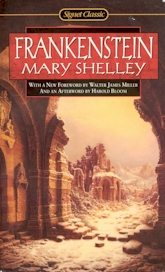
"Frankenstein" by Mary Shelley


From BarnesandNoble.com:

Mary Shelley began writing Frankenstein when she was only eighteen. At once a Gothic thriller, a passionate romance, and a cautionary tale about the dangers of science, Frankenstein tells the story of committed science student Victor Frankenstein. Obsessed with discovering "the cause of generation and life" and "bestowing animation upon lifeless matter," Frankenstein assembles a human being from stolen body parts but; upon bringing it to life, he recoils in horror at the creature?s hideousness. Tormented by isolation and loneliness, the once-innocent creature turns to evil and unleashes a campaign of murderous revenge against his creator, Frankenstein.

Frankenstein, an instant bestseller and an important ancestor of both the horror and science fiction genres, not only tells a terrifying story, but also raises rofound, disturbing questions about the very nature of life and the place of humankind within the cosmos: What does it mean to be human? What responsibilities do we have to each other? How far can we go in tampering with Nature? In our age, filled with news of organ donation genetic engineering, and bio-terrorism, these questions are more relevant than ever.

Friday, January 23, 2015

Now reading...

"The Pluto Files" by Neil deGrasse Tyson


From ThriftBooks.com:

When the Rose Center for Earth and Space at the American Museum of Natural History reclassified Pluto as an icy comet, the New York Times proclaimed on page one, “Pluto Not a Planet? Only in New York.” Immediately, the public, professionals, and press were choosing sides over Pluto’s planethood. Pluto is entrenched in our cultural and emotional view of the cosmos, and Neil deGrasse Tyson, award-winning author and director of the Rose Center, is on a quest to discover why. He stood at the heart of the controversy over Pluto’s demotion, and consequently Plutophiles have freely shared their opinions with him, including endless hate mail from third-graders. With his inimitable wit, Tyson delivers a minihistory of planets, describes the oversized characters of the people who study them, and recounts how America's favorite planet was ousted from the cosmic hub

Monday, January 12, 2015

Now reading...

"The Epic of Gilgamesh" by unknown


From BarnesandNoble.com:

The Epic of Gilgamesh, an epic poem from Mesopotamia, is amongst the earliest surviving works of literature. The story centers on a friendship between Gilgamesh and Enkidu. Enkidu is a wild man created by the gods as Gilgamesh's equal to distract him from oppressing the people of Uruk. Together, they journey to the Cedar Mountain to defeat Humbaba, its monstrous guardian. Later they kill the Bull of Heaven, which the goddess Ishtar sends to punish Gilgamesh for spurning her advances. As a punishment for these actions, the gods sentence Enkidu to death.